Why Your Sickness Absence Policy Is Probably Illegal (And You Don't Know It)
A client rang me last month, genuinely upset. One of her warehouse staff had been off six times in eight months. Short stuff — a day here, two days there. She'd pulled out the handbook her last HR consultant wrote in 2019, followed it to the letter, and issued a formal warning under their Bradford Factor trigger.
The employee went to ACAS. She settled for £4,200.
Here's the bit nobody told her: that Bradford Factor threshold she'd inherited wasn't just outdated, it was discriminatory. Two of those six absences were linked to a condition that qualified as a disability under the Equality Act 2010. Her policy didn't carve out reasonable adjustments. Her policy didn't even mention them.
This is the boring truth about sickness absence policies. They're the single most-copied document in UK HR. Someone writes one, it gets shared, it ends up in 400 handbooks, and three years later half of them are quietly indefensible.
What Actually Needs to Be in a 2026 Sickness Absence Policy
Five things — and most policies miss at least two of them.
1. A Clear Definition of Short-Term Versus Long-Term Absence
The threshold matters because it triggers different processes. Most policies fudge this or leave it at "manager's discretion," which is a tribunal gift.
2. Reasonable Adjustment Language That's Actually Operational
Not a paragraph saying you'll consider adjustments, but a process: who decides, what evidence you need, how long the review takes. Vague good intentions don't survive cross-examination.
3. Return-to-Work Interview Triggers
After every absence, not just the long ones. The data point most managers don't know: companies that interview after every absence see roughly 20% lower repeat absence. It's also your best documentation if things escalate.
4. SSP Mechanics in Plain English
The Statutory Sick Pay framework has moved on — most handbooks still describe the old waiting days. If your policy still says "SSP is payable from day 4," it's wrong. Your sick pay policy should match current SSP rules and point people to where rates are updated (they change with government upratings).
The Employment Rights Act 2025 makes two material changes to SSP that most policies haven't caught up with:
- Waiting days are being removed. SSP becomes payable from the first day of sickness, not the fourth. The exact implementation date is being set by secondary regulations, but the direction is final.
- The lower earnings limit threshold is being removed. Currently employees earning below the LEL are excluded from SSP entirely. Under ERA 2025, all employees become eligible regardless of earnings, with the rate calculated as a percentage of normal earnings for lower earners.
If your sick pay policy says "SSP is payable from day 4" or refers to a "lower earnings limit qualifying threshold," it is now wrong in two places.
5. A Trigger System That Isn't Only Bradford Factor
Bradford Factor is fine as one input, but using it as your sole trigger is lazy and increasingly risky. Pattern-based triggers — frequency plus context — hold up better, especially where disability or pregnancy-related absence is in play.
The Bit Most People Skip: AI-Monitored Attendance
You also need a written statement on AI-monitored attendance. If you use any tool that flags absence patterns, predicts likely sickness, or scores attendance risk — and increasingly that includes mainstream HRIS platforms, not just specialist tools — you may have UK GDPR Article 22 obligations around automated decision-making.
The trigger is whether decisions are made "solely on automated processing" with "legal or similarly significant effects." A Bradford Factor calculation that auto-generates a warning letter without human review is more likely to be caught by Article 22 than the same calculation reviewed by a manager who decides whether to action it.
What a 2026 sickness absence policy needs to address:
- Whether automated tools are used in attendance monitoring at all
- What role they play in the decision-making process (informational vs decisional)
- The right to human review of any automated decision
- The right to obtain an explanation of the logic involved
- The contestability route if the employee disagrees with the automated assessment
Almost no SME handbook addresses any of this. The ICO has not yet issued a major enforcement action on Article 22 in the employment context, but the regulatory direction of travel is clear, and the first cases are likely to come from employees who have been formally disciplined or dismissed based on AI-flagged attendance patterns.
The honest read is that most SMEs using HRIS attendance tools haven't documented their AI use because they don't think of it as AI use. By the time the regulator notices, the gap will be uncomfortable.
The Honest Take
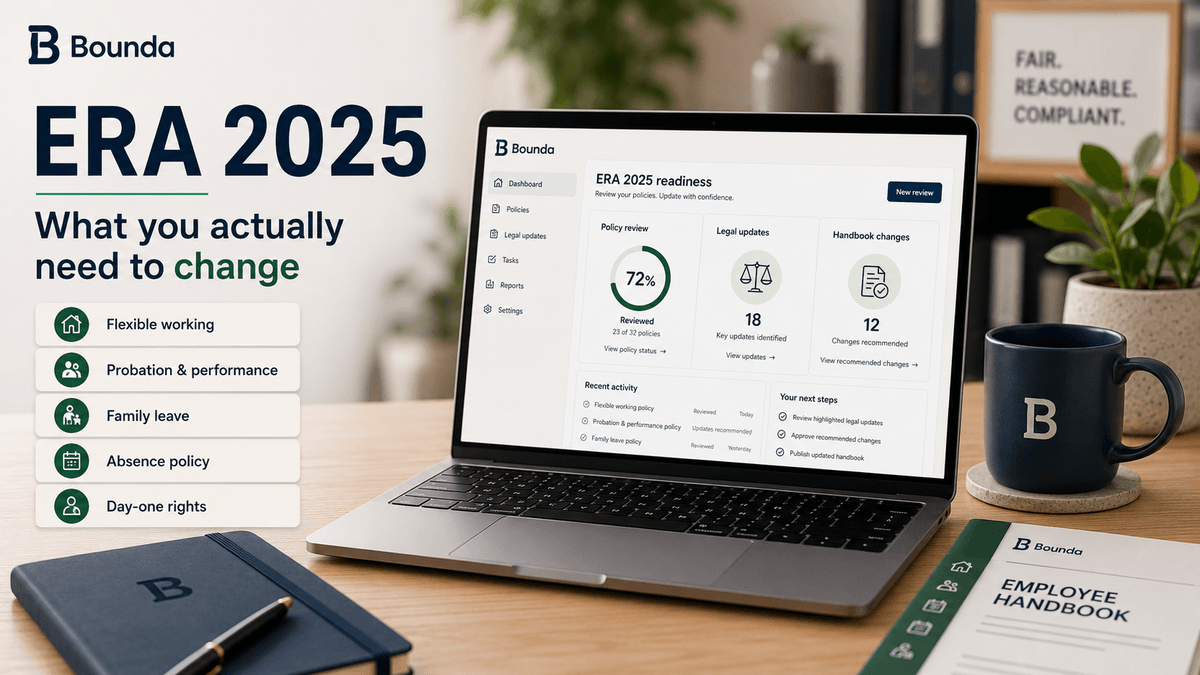
Most sickness policies aren't broken because they're badly written. They're broken because they were written once, in a different legal climate, and nobody's gone back. The Employment Rights Act 2025 is going to surface a lot of these quietly buried problems over the next 18 months, particularly the day-one rights changes. If your policy still treats the first two years as a probation-grade write-off zone, you've got work to do. See our ERA 2025 changes action list for what to fix first.
Bounda flags this stuff automatically. But honestly, even without us, this is a 90-minute job that could save you a five-figure settlement.
Common questions about UK sickness absence policies
Is a sickness absence policy legally required?
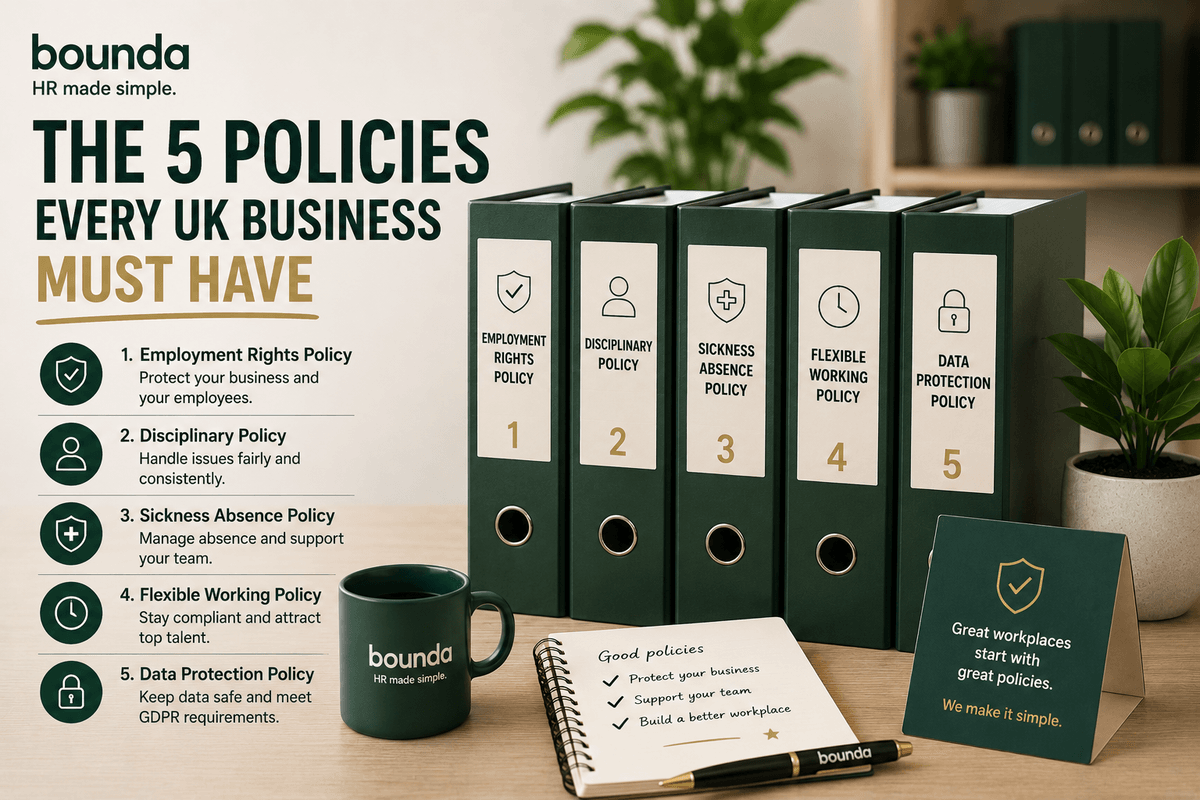
There is no specific statute requiring a sickness absence policy as a standalone document. However, the disciplinary and grievance procedure requirements under ERA 1996 Section 3, the Equality Act 2010 duty to consider reasonable adjustments, and the data protection requirements of UK GDPR collectively mean that any employer with employees needs documented processes covering absence. Most employers consolidate these into a sickness absence policy. For the core legally required policies, see our separate guide.
Is the Bradford Factor legal in the UK?
The Bradford Factor itself is not unlawful — it's a scoring formula. What can be unlawful is applying it without reasonable adjustment for disability-related absence, or using it as the sole trigger for disciplinary action without considering context. Several tribunal cases have found Bradford-Factor-led dismissals unfair where disability or pregnancy-related absence drove the score.
When does sickness absence become disability under the Equality Act?
When the underlying condition meets the definition of "disability" — a physical or mental impairment that has a substantial and long-term adverse effect on the ability to carry out normal day-to-day activities. "Long-term" means lasting or expected to last 12 months or more. Mental health conditions, chronic pain, autoimmune conditions, cancer, and several others can qualify even when the day-to-day impact varies.
Does ERA 2025 change sickness absence rules?
Yes, in two main ways. SSP becomes payable from day one (removing the previous three waiting days), and the lower earnings limit qualifying threshold is being removed so all employees become eligible. Most existing handbook wording on SSP is now out of date.
Can you fire someone for being sick too often?
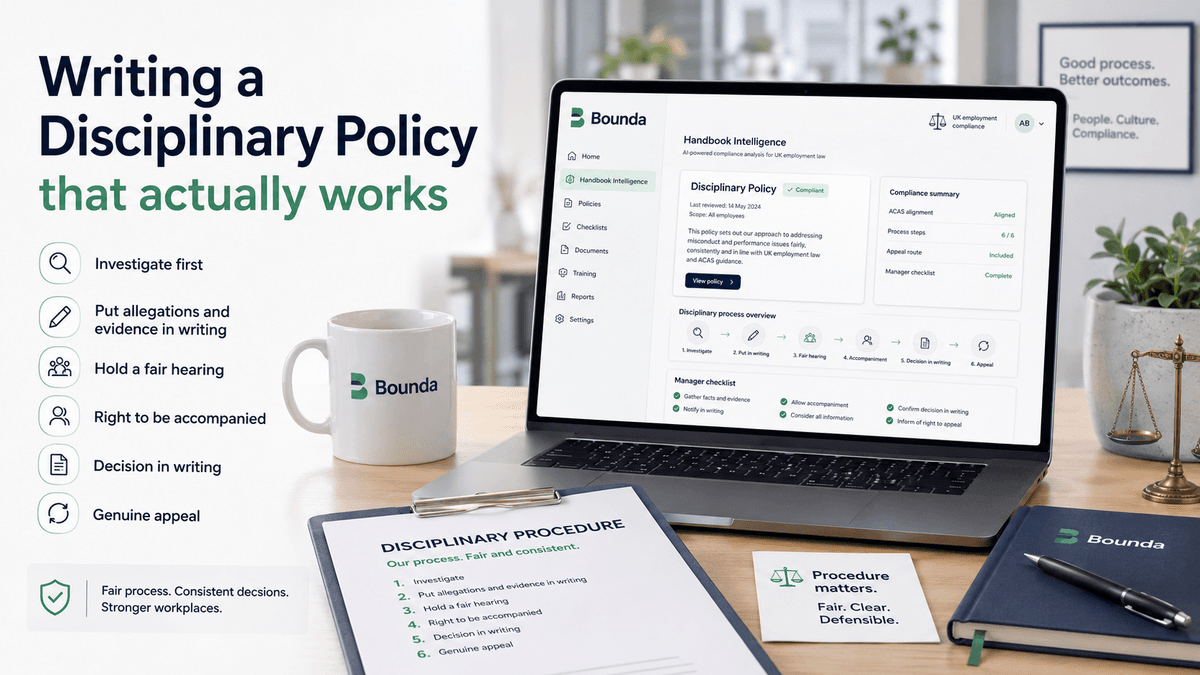
Capability dismissal on grounds of ill-health is lawful in principle, but the procedural and substantive bar is high. The employer must obtain medical evidence, consider reasonable adjustments, consider redeployment, hold capability hearings, and follow the ACAS Code. Where the underlying condition is a disability, the employer must demonstrate that reasonable adjustments were genuinely considered and tried. Dismissing on attendance grounds without these steps is the most common single cause of disability discrimination claims in the UK. Your disciplinary procedure is where this usually falls apart in practice.