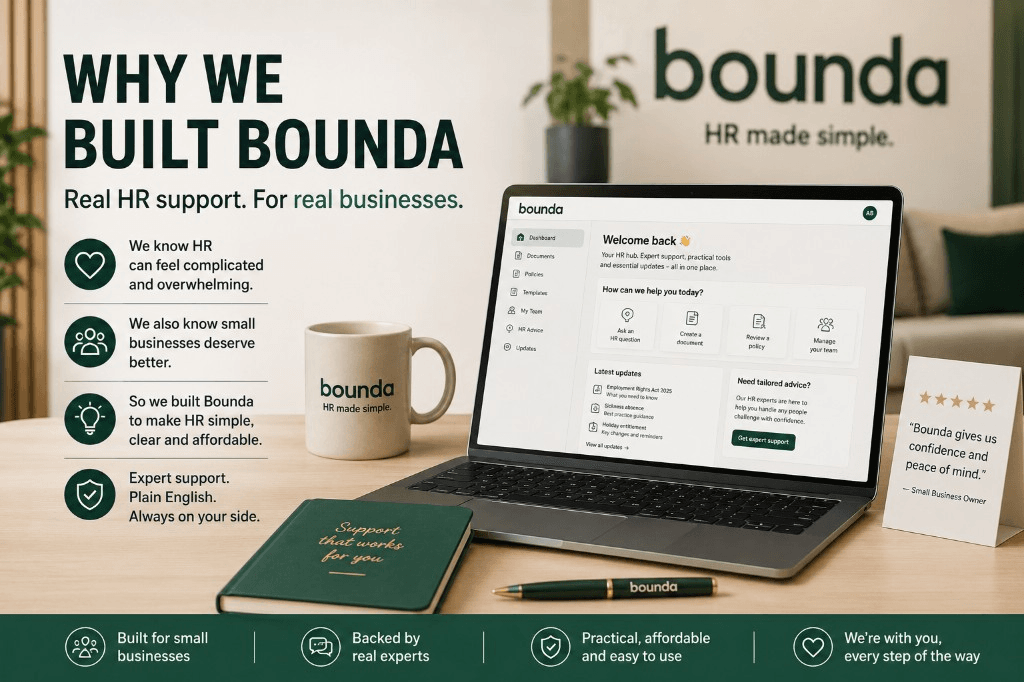
Why I Built Bounda
This isn't a founding story with a moment of clarity. There wasn't a napkin, a shower, or a flight back from somewhere. The reason Bounda exists is more boring than that, and more useful.
I've spent over thirty years running, building, and advising UK businesses. Field staff, office teams, contractors, acquired businesses being integrated into bigger ones. Different sectors, different operational shapes, the same underlying realities. Across all of it, one pattern repeated more often than any other.
The HR documentation was always out of date. Nobody noticed until something went wrong. When something went wrong, the cost was disproportionate to the original gap.
Tribunals settled over wording that had been wrong in handbooks for years. Disciplinary processes that satisfied a template from 2015 were dismantled at hearing because the template was no longer current. Reasonable adjustments that nobody had thought through, because the policy didn't surface them. Sickness absence triggers that worked on paper and failed the moment a disability claim entered the picture.
And these weren't badly run businesses. They were profitable, growing, well-intentioned operations with managers doing their best. The documentation just couldn't keep up. The gap shows up in the documents most SMEs miss as much as in the ones they think they have covered.
The £600 / £3,000 Problem
The options I kept seeing for fixing this were both bad.
You could buy a template pack for £600. Forty or fifty documents from an online provider, generic, often factually wrong on the day they were sold to you. Or you could engage an employment solicitor at £300 an hour and pay £3,000 for a properly drafted handbook that would also be out of date within eighteen months unless you paid again.
Neither option scaled. A small business doesn't have a person whose job is to watch UK employment law and update the handbook quarterly. It has an owner who has fifty other priorities and a vague memory that the handbook is "probably fine."
The market had two answers. Cheap and wrong, or expensive and frozen. Most SMEs picked cheap because the expensive option felt aspirational.
That was the gap. Not a market that needed another HR tool. A market that needed a way to keep documentation current without paying solicitor rates every quarter. For what the law requires, that is the statutory floor. The operational gap is often wider.
Why AI Changes This
The reason I'm building Bounda now and not three years ago is straightforward: large language models are finally good enough to genuinely understand a handbook in context.
Earlier generations of HR software did keyword matching and document templating. They could tell you "you don't have a flexible working policy." They couldn't tell you "your sickness absence policy says X, and that's a problem because of how the Equality Act interacts with the specific Bradford Factor trigger you've set."
That second sentence is what an HR consultant does for £300 an hour. It's what most small businesses don't have access to. And it's now technically possible to deliver as software, at a price that an SME would actually pay.
What Bounda Is Trying to Do
Three things specifically.
First: make compliance analysis cheap enough that SMEs actually use it. The compliance work that previously required a solicitor engagement should be available as software, with continuous monitoring rather than a one-time review.
Second: keep humans in the loop where it matters. AI surfaces what's wrong and explains why. Humans decide what to do about it. We don't auto-publish policy changes. We don't make dismissal recommendations. The accountability stays where it belongs.
Third: be honest about what we can't do. Complex tribunal cases need solicitors. Specific industry overlays need specialist advisers. Bounda is the layer between "no expertise" and "expensive expertise," and we're not going to pretend to be the latter.
What I Believe About HR Tech
Most HR software is built for HR teams. Bounda is built for businesses that don't have HR teams.
That changes everything about how the product needs to work. The user is a business owner with no formal HR training, no time to read CIPD guidance, no patience for software that requires onboarding. The interface has to be intelligible to someone who doesn't know what a Section 1 statement is, and shouldn't need to. The advice has to be specific enough to act on without being so specific that it becomes wrong in their context.
That's a harder product problem than building software for HR professionals. It's also the more important one. The compliance gap in UK SMEs isn't an HR-team problem. HR teams generally know what they're doing. The gap is in the businesses that don't have one, and there are a lot of those.
What's Next
The handbook builder, compliance analysis, and AI chatbot are live. Document generation is in active development. We're tracking Employment Rights Act 2025 changes in real time as the secondary regulations land.
If you run an SME and you're not sure whether your handbook is current, the honest answer is that it probably isn't. The pattern I've watched repeat for thirty years says so. Try Bounda for seven days. If we find nothing, you've lost nothing. If we find something, you'll know what to fix.
The worst thing you can do is leave the question open until the next tribunal answers it for you.
Chris Carswell
Founder, Bounda