Writing a Disciplinary Policy That Actually Works
A retail manager called us last spring. She had just dismissed someone for gross misconduct — verified theft on CCTV, witnessed by two colleagues, signed statement from the employee admitting it. Open and shut, in her words. The tribunal awarded the dismissed employee £8,600.
The misconduct was real. The dismissal was substantively fair. What lost the case was the procedure. The investigation was carried out by the same person who chaired the disciplinary hearing. The employee was not told in writing what evidence was being relied on. The right of appeal letter went out the same day as the dismissal, which the panel decided was not meaningful notice.
The policy in her handbook said all the right things. The execution did not match the policy. And the policy was vague enough that the gap was not obvious until it was too late.
This is what most disciplinary policies miss. Not the ACAS Code — everyone references that. The operational specifics that turn principles into procedure. Every business needs a disciplinary policy. It is not optional — it is among the policies that are legally required in the UK, and tribunals will ask to see it.
Why This Matters More in 2026
Under the pre-Employment Rights Act 2025 framework, most dismissals during an employee's first two years carried limited tribunal risk. Capability and conduct dismissals could be handled relatively informally, with the unfair dismissal clock not starting until two years of service.
The Employment Rights Act 2025 cuts that to six months. The cushion is largely gone. A disciplinary process that was previously irrelevant for the first 18 months of someone's employment is now relevant from month six — and your probation framework needs to reflect that, not the old two-year assumption.
This does not change what a good disciplinary policy looks like. It changes how often it gets tested. For the practical ERA 2025 handbook updates, see our ERA 2025 action list.
If your policy has been sitting unused since 2019, the next case you bring under it is probably the case that finds out whether it actually works.
What ACAS Actually Says
The ACAS Code of Practice on Disciplinary and Grievance Procedures is the floor, not the ceiling. It is not law, but Section 207 of the Trade Union and Labour Relations (Consolidation) Act 1992 allows tribunals to increase a successful claimant's compensation by up to 25 percent for unreasonable failure to follow it.
The principles, in plain terms:
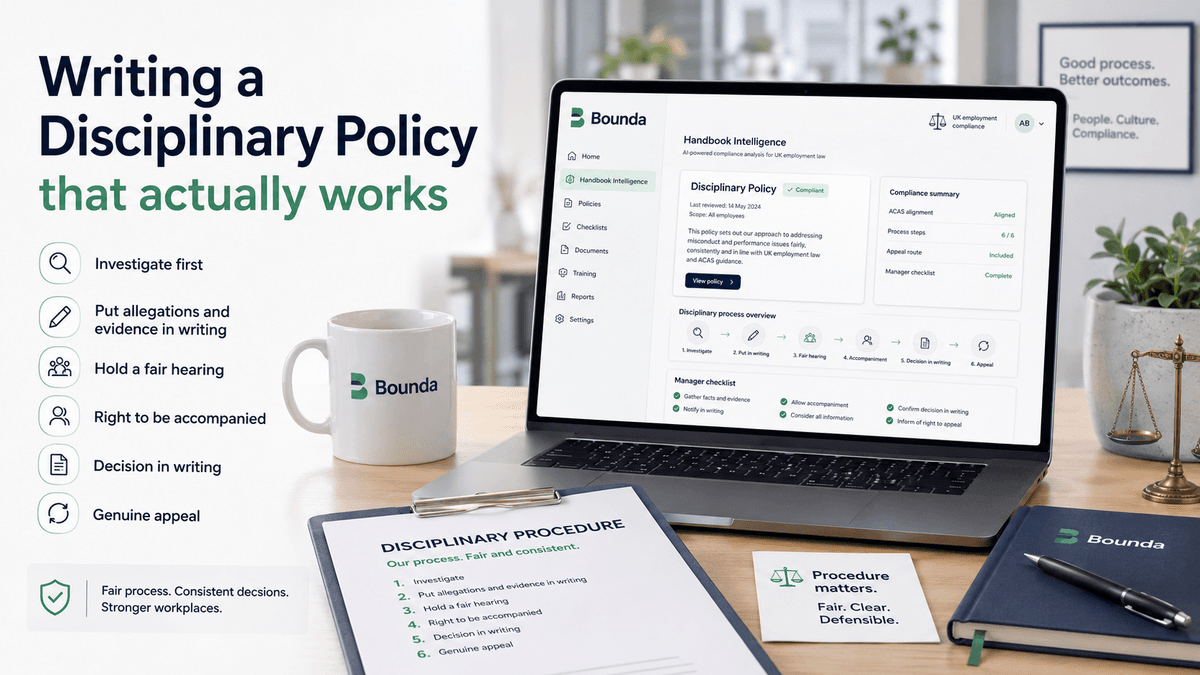
- Investigate before you accuse. Establish the facts before initiating formal disciplinary action. The investigation and the decision should be done by different people wherever possible.
- Inform the employee in writing. What the allegation is, what evidence is relied on, what the potential outcome is, and when the hearing will be. Vague invitations to "discuss some concerns" do not qualify.
- Hold a hearing. Give the employee a chance to respond. Allow reasonable time to prepare. Reschedule once if necessary.
- Allow the employee to be accompanied. By a work colleague or trade union representative. This is a statutory right under Section 10 of the Employment Relations Act 1999.
- Decide and inform in writing. The decision, the reasoning, and the right of appeal. The appeal route must be to someone who was not involved in the original decision.
- Give a genuine right of appeal. Same-day appeal letters, or appeals heard by the original decision-maker, do not count as genuine.
That is the procedural minimum. Everything in the policy is detail. But the detail is where most tribunal cases are actually lost.
The Structure That Actually Holds Up
1. Scope and Application
Who it applies to (employees, workers, contractors — be specific), and what conduct it covers. Two paragraphs is enough.
Common omission: failure to address contractors and casual workers explicitly. Tribunals have increasingly found that worker status (not just employee status) carries some procedural protections, and policies that say nothing about workers create ambiguity that is hard to defend.
2. Informal Resolution
Most conduct issues do not need formal process. A quiet conversation, a follow-up email confirming what was discussed, and a note on the file is often the proportionate response.
Your policy should explicitly authorise this. The risk if it does not: managers either escalate prematurely (triggering formal process unnecessarily) or sit on issues hoping they resolve themselves (creating gaps that look like inconsistent treatment when comparing later cases).
3. Investigation
Who investigates. Name a role, not a person. "The line manager's manager" or "an HR business partner not involved in the immediate situation" is more durable than naming individuals.
Investigation standards. State the evidence threshold — usually balance of probabilities, but for gross misconduct cases involving criminal-style allegations (theft, fraud), tribunals expect a higher standard of evidence-gathering even though the legal threshold remains civil.
Timescales. Set a realistic investigation window (typically 10–15 working days for straightforward cases) with provision to extend in writing for complex cases. Open-ended "as soon as possible" investigations are a procedural failure waiting to happen.
4. The Disciplinary Hearing
Notice. Minimum five working days between the invitation and the hearing, including all evidence and witness statements. Less than this is a frequent procedural failure.
Who chairs. Different from who investigated. This is the single most common failure point in SME disciplinary procedures.
Right of accompaniment. State it explicitly. State who qualifies. State that delays of up to five working days to accommodate the chosen companion are acceptable.
Adjournments. Build in the right to adjourn for further investigation if new points emerge during the hearing. Decisions made under time pressure without addressing new evidence are vulnerable on appeal.
5. Outcomes
The standard outcome ladder — informal warning, written warning, final written warning, dismissal — should be explicit but not rigid. The policy should explicitly allow skipping steps for sufficiently serious conduct (with the procedural caveat that you must say so in the invitation letter, not introduce it for the first time at the hearing).
For gross misconduct, the policy should distinguish summary dismissal (without notice) from dismissal with notice. The summary route is reserved for conduct that fundamentally breaches the contract, and tribunal cases increasingly require evidence that the employer genuinely considered the alternative of dismissal with notice.
6. Appeals
Timescale to lodge. Typically 5–10 working days from the date of the decision letter. State it clearly.
Who hears the appeal. Someone not previously involved. For very small employers where this is genuinely impossible, the policy should explicitly authorise the use of an external HR consultant or ACAS as an alternative.
Scope of the appeal. Whether it is a review (limited to the existing evidence) or a re-hearing (open to new evidence and arguments). Most policies do not specify, and the lack of clarity becomes a procedural argument later.
The appeal outcome. Should be in writing, with reasoning, and is normally final internal to the business.
What Most Policies Get Wrong
Three patterns account for most SME disciplinary failures we see at tribunal:
- Single-person procedure. The same manager investigates, chairs the hearing, makes the decision, and is the only person available to hear the appeal. This is the most common procedural failure in small businesses, and it is structurally unfixable without policy that explicitly authorises external alternatives.
- Vague misconduct lists. A policy that says "serious misconduct may result in dismissal" without examples means every dismissal decision becomes a fresh argument about whether the specific conduct qualifies. Non-exhaustive lists of misconduct types (with explicit "this is not exhaustive" language) work much better.
- Borrowed templates without local fit. Most SME disciplinary policies were written by someone else's solicitor for someone else's business. The procedural references work in their original context but break in yours (different roles, different reporting lines, different sectoral considerations).
Bounda surfaces all three when you run a handbook through compliance analysis. The reason this matters to us specifically is in the founder's story. But you do not need software to fix them — you just need to read your own policy with these three failure modes in mind.
The harder question is whether your managers can actually run the process the policy describes. That is a training problem, not a documentation problem. A perfect policy with untrained line managers is worse than a flawed policy with experienced ones.
Working Templates
Disciplinary invitation letter
Dear [name],
I am writing to invite you to a disciplinary hearing under our disciplinary procedure. The hearing will take place on [date and time] at [location/video link].
The allegation we are considering is: [specific allegation, with dates and reference to specific incidents]. This is being considered as [misconduct / gross misconduct / serious misconduct].
The evidence we will rely on at the hearing is enclosed with this letter and includes: [list].
At the hearing you will have the opportunity to respond to the allegation and to put forward any mitigating factors. You have the right to be accompanied by a work colleague or trade union representative. If the companion you choose is not available on the proposed date, the hearing can be rescheduled by up to five working days.
The possible outcomes include [warning / final warning / dismissal]. [If gross misconduct: This may include summary dismissal without notice.]
Please confirm your attendance and the name of any companion in writing.
Decision letter
Dear [name],
Following the disciplinary hearing on [date], I am writing to confirm the outcome.
After considering the evidence and your response, my decision is: [outcome]. My reasoning is: [two or three sentences].
[If warning: This warning will remain on your file for [period].]
[If dismissal: The dismissal takes effect on [date]. Your notice/payment in lieu of notice details are: [...].]
You have the right to appeal this decision. To appeal, write to [name/role] within [5/10] working days, setting out the grounds for your appeal.
Manager's procedural checklist
Before initiating:
- Have I identified the specific allegation and dates?
- Is there a separate investigator available?
- Have I considered whether informal resolution is more appropriate?
During the process:
- Was the invitation letter sent with at least 5 working days' notice?
- Was the evidence shared with the employee in advance?
- Did the employee have the opportunity to be accompanied?
- Were witness statements taken and shared?
- Was the hearing chaired by someone different from the investigator?
After the decision:
- Was the decision communicated in writing with reasoning?
- Was the right of appeal stated explicitly?
- Was the appeal hearer different from the original decision-maker?
- Did the appeal happen within reasonable timescales?
Common questions about UK disciplinary policy
Is a written disciplinary policy a legal requirement?
Yes for employees. Section 3 of the Employment Rights Act 1996 requires employers to provide written disciplinary and grievance procedures as part of the statement of particulars. The policy itself does not need to be elaborate, but the procedure needs to be available to the employee in writing.
Does the ACAS Code apply to small businesses?
Yes. The Code applies regardless of headcount. Tribunals can increase awards by up to 25 percent for unreasonable failure to follow it, and decrease awards by up to 25 percent where the employee unreasonably failed to follow it. The small-employer exemption that existed pre-2009 is no longer in force.
How long should a disciplinary process take?
The ACAS Code says "without unreasonable delay." In practice, straightforward cases should complete within 4–6 weeks from initial investigation through to outcome. Complex cases can take longer. Cases dragging beyond 3 months without clear reason are often successfully challenged as procedurally unfair.
What's the difference between misconduct and gross misconduct?
Misconduct is conduct that warrants a disciplinary response but does not fundamentally breach the employment contract. Examples: lateness, poor performance against documented standards, failure to follow reasonable instructions.
Gross misconduct is conduct that fundamentally breaches the contract and justifies summary dismissal (dismissal without notice). Examples: theft, violence, fraud, serious insubordination, deliberate breach of safety rules with risk of harm.
The distinction matters because gross misconduct allows summary dismissal, but only after a fair procedure. "Gross misconduct" is not a procedural shortcut.
Can we suspend an employee during investigation?
Yes, but suspension should be on full pay, kept under review, used only when continued attendance would be inappropriate (e.g. risk of evidence tampering, safeguarding concerns), and clearly communicated as a neutral act, not a sanction. Routine suspensions, or extended suspensions without clear justification, are vulnerable to constructive dismissal claims.